

Why Inspection Reports Get Rejected by Auditors (and How to Fix It)

Why Inspection Reports Get Rejected by Auditors (and How to Fix It)

Inspection reports are rejected far more often than organizations expect. Not because inspections were skipped. Not because teams failed to do their work.

Inspection reports get rejected because they fail to prove, beyond doubt, that inspections were executed correctly, consistently, and under control.

Auditors do not evaluate effort. They evaluate evidence credibility.

Across manufacturing, logistics, infrastructure, and regulated operations, we see the same pattern repeat: inspections happen, but the documentation cannot withstand audit scrutiny. This gap between execution and evidence is the real reason inspection reports rejected by auditors become a compliance liability.

This article breaks down how auditors evaluate inspection evidence, the most common documentation failures that trigger report rejection, and how a purpose-built inspection checklist app like Emory Pro closes these gaps—without adding operational burden.

Written for quality managers, operations leaders, and compliance teams responsible for maintaining audit-ready inspection programs.
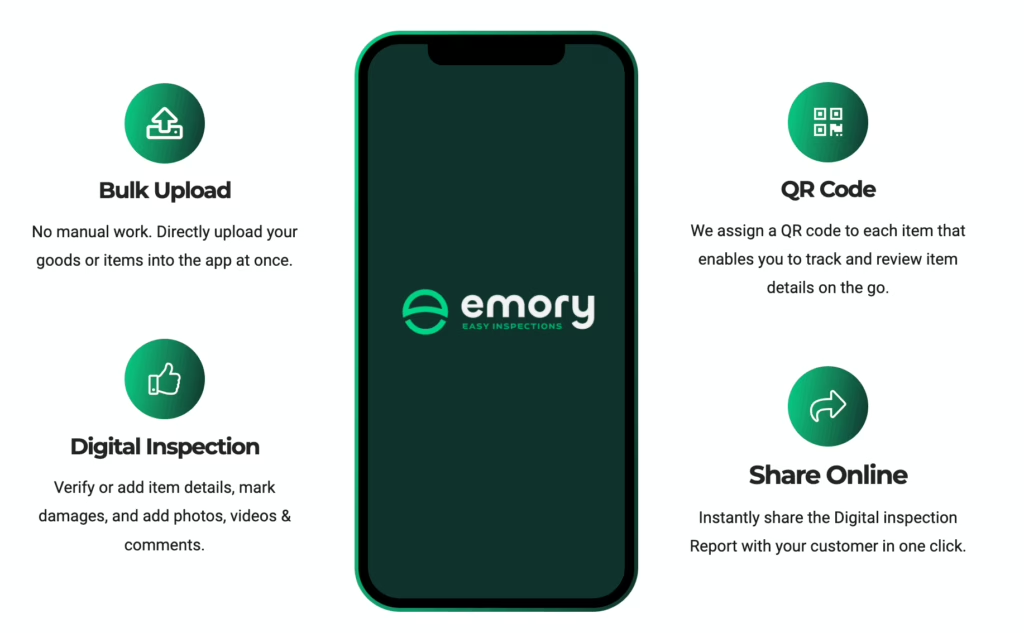
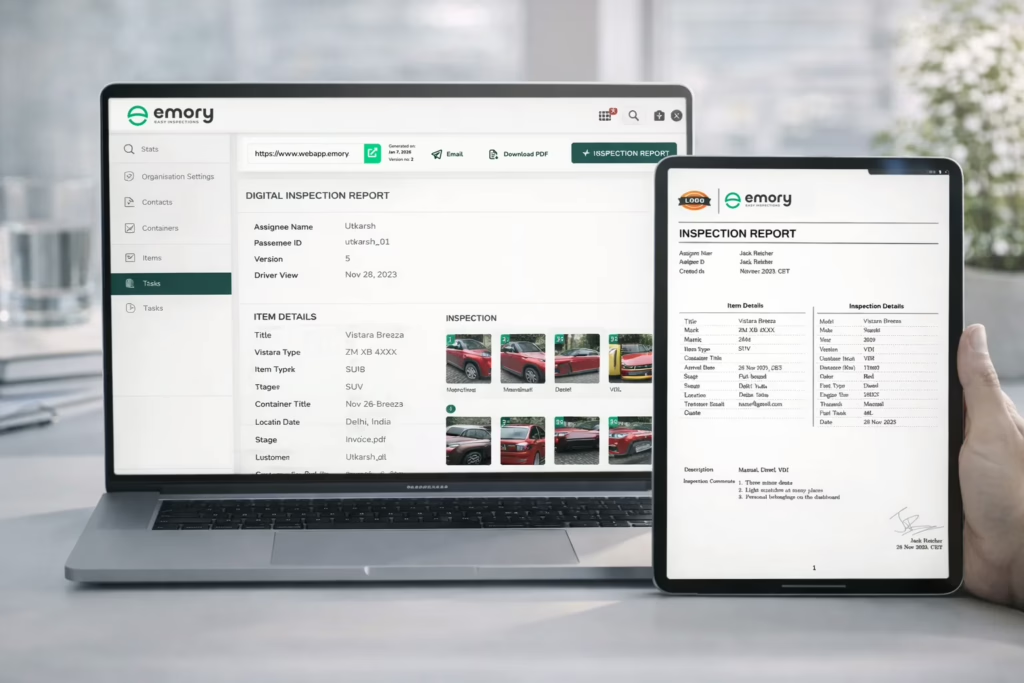
Why Auditors Reject Inspection Reports?

Auditors reject inspection reports when the documentation cannot independently verify execution.

This usually happens when reports:

  • Contain missing or incomplete data
  • Depend on verbal explanation to make sense
  • Cannot prove when the inspection occurred
  • Use vague acceptance criteria
  • Do not link inspection findings to corrective actions

From an audit perspective, any missing or unverifiable element breaks the evidence chain. Once the chain breaks, the report is treated as unreliable, even if the inspection itself was properly performed.

This is why inspection reports are rejected even in high-performing organizations.

How Auditors Evaluate Inspection Reports?

Auditors do not read inspection reports like operators do. They assess them as standalone proof.

An inspection report must answer five questions clearly, without context or explanation:

  1. What was inspected
  2. Who performed the inspection
  3. When it was performed
  4. Against which defined criteria
  5. What happened when results were outside limits

If a report cannot answer all five clearly, auditors do not “fill in the gaps.” They flag the report.

This approach protects audit objectivity and prevents assumptions. But it also exposes weaknesses in how inspection data is captured and stored.

Teams using Emory Pro typically see fewer audit observations because inspection evidence is captured correctly the first time.

The Inspection Evidence Chain (Why One Gap Invalidates the Report)

Inspection reports are not evaluated line by line. They are evaluated as an evidence chain.

The chain links: Inspection planInspection executionRecorded resultsAcceptance criteriaCorrective action

If any link is weak or missing, the entire report loses credibility.

  • Example: A measurement without tolerance limits cannot confirm acceptance.
  • Example: A checklist without a verified timestamp cannot confirm execution timing.
  • Example: A deviation without corrective action cannot demonstrate control.

Auditors do not partially accept inspection evidence. It either holds together, or it does not.

Most Common Reasons Inspection Reports Get Rejected (and How to Fix Them)

Inspection reports are not rejected randomly. Auditors follow a consistent evaluation logic, even if they never explain it explicitly.

When an inspection report is rejected, it usually fails one or more credibility checks auditors rely on to determine whether the inspection truly happened as claimed. Below are the most common reasons, explained from the auditor’s point of view, and how Emory Pro solves them.

1. The Report Cannot Prove When the Inspection Was Performed

One of the first things auditors look for is execution timing. If an inspection report cannot clearly demonstrate when the inspection occurred, the auditor cannot confirm that the inspection was performed as required.

This problem commonly appears when:

  • Reports are filled at the end of a shift
  • Dates are entered manually
  • There is no distinction between inspection time and reporting time

From an audit perspective, delayed or editable timestamps introduce uncertainty. Once timing is uncertain, the inspection itself becomes unverifiable.

How Emory Pro Fixes This: Emory Pro eliminates “phantom inspections” by automatically capturing immutable timestamps the moment an inspection starts. Even if a user is offline, the app records the exact device time, creating a verifiable digital audit trail that auditors trust.

2. Acceptance Criteria Are Not Explicitly Visible

Auditors do not accept conclusions without context. Statements such as “OK,” “Pass,” or “Within limits” do not qualify as audit evidence unless the acceptance criteria are documented alongside the result.

Many inspection reports fail because:

  • Criteria exist in procedures but not in reports
  • Limits are assumed to be “known”
  • Results are recorded without measurable thresholds

When acceptance criteria are missing, auditors cannot independently verify compliance. At that point, the report becomes an opinion—not evidence.

How Emory Pro Fixes This:  With customizable inspection forms, Emory Pro embeds the criteria directly into the checklist workflow. Inspectors see the required tolerance (e.g., “Min 1.6mm”), and the final report displays the result against that standard, leaving no room for ambiguity.

3. Inspector Accountability Cannot Be Clearly Established

Inspection reports must establish who was responsible for execution. Auditors raise concerns when names are missing, initials are unclear, or one identity appears across multiple shifts or locations.

This is not about blame. It is about traceability. If responsibility cannot be clearly attributed, auditors cannot confirm that inspections were performed by authorized or qualified personnel.

How Emory Pro Fixes This: Emory Pro requires individual secure logins. Every data point is digitally signed and linked to a specific user profile. This establishes 100% accountability and ensures only authorized staff can perform specific vehicle inspections.

4. Inspection Results Exist Without Documented Follow-Up

Inspection reports are not meant to capture results alone. They are meant to demonstrate control.

Auditors expect inspection records to show:

  • What deviation occurred
  • What action was taken
  • Whether the issue was addressed

When inspection findings are documented without visible follow-up, auditors interpret the system as reactive. Reactive systems are flagged because they do not demonstrate sustained process control.

How Emory Pro Fixes This: Our system closes the loop. If an inspector fails an item, the app triggers a mandatory corrective action workflow. You cannot “just submit” a failed report without flagging the issue, ensuring the defect is tracked until resolution.

5. Inspection Records Cannot Be Retrieved Reliably

Auditors do not only assess content. They assess accessibility.

Inspection reports are rejected when records are scattered, retrieval takes excessive time, or historical reports are inconsistent. In audits, inability to produce evidence quickly is treated the same as the absence of evidence.

How Emory Pro Fixes This: Stop digging through filing cabinets. Emory Pro centralizes all data in the cloud. You can retrieve any report by asset ID, date, or inspector in seconds, turning a stressful audit into a simple search task.

Why Manual Inspection Reporting Breaks Under Audit Pressure?

Manual inspection reporting relies heavily on human discipline. It cannot consistently enforce mandatory data entry, execution-time documentation, or identity verification.

As audit scrutiny increases, these limitations become visible. The issue is not people. It is that the documentation system was never designed to protect evidence integrity under review.

How an Inspection Checklist App Improves Audit Credibility?

A Digital inspection app improves audit outcomes by structuring how evidence is captured, not by adding complexity.

When designed correctly, it ensures:

  • Required fields cannot be skipped (Solving Reason #1)
  • Execution time is captured automatically via immutable timestamps
  • Inspector identity is recorded at the moment of log-in
  • Acceptance criteria are embedded directly in the checklist (Solving Reason #2)
  • Deviations trigger documented follow-up workflows automatically

This reduces ambiguity and strengthens the inspection evidence chain without increasing the workload for the frontline team.

How Emory Pro Helps Reduce Report Rejections?

Emory Pro focuses on how inspection evidence is created, structured, and preserved. Our approach helps teams:

  • Capture inspection data at execution time to eliminate retroactive reporting.
  • Standardize inspection documentation across locations to satisfy auditor expectations.
  • Maintain traceability without manual effort using digital logs.
  • Link inspection results to follow-up actions for a complete audit trail.
  • Retrieve inspection records quickly during audits with instant search.

The goal is not digitization for its own sake. It is the clarity and defensibility of inspection evidence.

Final Thought

Inspection reports get rejected when they fail to prove execution beyond doubt.

In modern audits:

  • Intent is not assumed.
  • Effort is not inferred.
  • Evidence must stand on its own.

Strong inspection reporting is not about doing more work. It is about capturing the right proof at the right moment. Start your free trial with Emory Pro today and ensure your next audit is your easiest one yet.

FAQ’s

Because auditors assess verifiable evidence, not intent. Missing or editable timestamps, absent acceptance criteria, unclear inspector identity, or a lack of follow-up make a perfectly executed inspection look unverifiable. Emory Pro prevents this: immutable start/finish timestamps, user-authenticated entries, embedded criteria, photos and measurement fields all tied to the record so auditors can verify execution at a glance.

Late or retroactive entries break the evidence chain. Emory Pro captures execution time automatically (even offline), maintains a tamper-evident edit history, and locks submitted records — removing the “back-filling” risk that triggers findings.

Auditors want a clear link from the finding to the corrective action and closure evidence. Emory Pro forces a corrective-action workflow for failures, attaches actions to the original record (photos, assignee, due date, closure proof) and timestamps each action — so “issue noted” becomes demonstrable resolution.

Start your free trial today.

Get all features, no risk.
No credit card needed – try Emory free today.