

How to Reduce Damage Disputes with Photo-Proof Container Reports?

How to Reduce Damage Disputes with Photo-Proof Container Reports?

Damage disputes remain one of the most persistent sources of friction in container logistics. Each dispute delays settlements, absorbs operational time, and weakens trust between depots, transporters, shipping lines, and cargo owners. In most cases, the issue does not originate from the damage itself. It originates from how inspections are documented.

Photo-proof container reports reduce disputes by turning inspections into reliable, traceable records of truth. When condition, location, and timing are captured together at the moment responsibility changes, accountability becomes clear and defensible.

This is the principle behind modern digital inspection workflows and the reason platforms like Emory Pro exist: to make inspections accurate, connected, and dependable in real operational environments.
Why Do Damage Disputes Continue Despite Regular Inspections?

Container inspections happen every day across ports, depots, and transport networks. Disputes still arise because most inspection workflows were designed around legacy processes rather than real operational risk.

Photos often sit in personal devices. Notes remain unstructured. Inspection timing stays unclear. Evidence fragments across emails, spreadsheets, and messaging apps. When a claim emerges weeks later, teams struggle to reconstruct what actually happened.

High-performing logistics organizations treat inspections as a core operational system. They design inspections to produce evidence that holds up under pressure, not just records that tick a box.

How Photo-Proof Container Reports Reduce Damage Disputes?

Photo-Proof Container Reports as an Operational Control System

Photo-Proof Container Reports as an Operational Control System

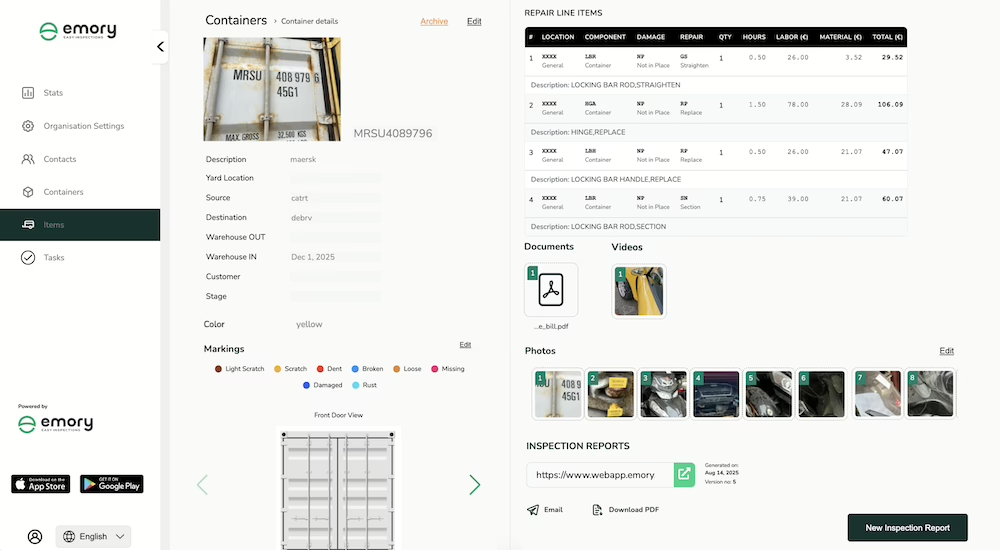
Photo-proof container reports work when inspections flow naturally from the field into a single, reliable system. In practice, this requires a quality control checklist app that guides inspectors through standardized inspection steps while capturing visual evidence, location data, and timestamps in real time.

Digital inspection App platforms such as Emory Pro support this by replacing fragmented workflows with connected, mobile-first inspections. Inspectors document container conditions on-site. Photos, GPS location, timestamps, and inspection data remain bound together.

This approach reflects Emory Pro’s core philosophy: inspections should feel effortless for teams while remaining dependable for the business.

Establishing Liability with Negative Proof in Container Inspections

Negative proof plays a decisive role in container damage claims. It documents the absence of damage at a specific custody point and establishes a verified baseline condition.

Inspectors capture images of clean container floors, intact walls, undamaged ceilings, and dry surfaces before loading or at gate-in. These images confirm sound conditions at the moment responsibility begins.

When damage appears later, negative proof provides clarity. Claims discussions shift from speculation to verification. Liability becomes traceable rather than disputed.

Operational takeaway:
Inspection workflows should deliberately document undamaged areas, not only visible defects.

Building Defensible Evidence with Structured Visual Documentation

Building Defensible Evidence with Structured Visual Documentation

Damage documentation requires more than a single photograph. Effective inspection systems apply a structured visual method that establishes identity, location, and severity together.

Establishing Context and Container Identity

The first image provides context. It captures the damaged area and the container number in the same frame, along with surrounding structural elements.

This image anchors the evidence to a specific container and location.

Establishing Scale and Severity

The second image captures detail. A close-up shows the damage alongside a reference object such as a ruler, coin, or standardized marker. This image communicates size, depth, and material impact.

Together, these images form a complete evidentiary unit. Claims teams evaluate damage accurately without follow-up clarification.

This structured approach aligns with Emory Pro’s design principle of making inspections clearer and more reliable through guided workflows.

Protecting Against Theft Claims with Seal Integrity Documentation

Seal-related disputes frequently determine responsibility in cargo theft cases. Seal evidence carries weight only when its integrity is demonstrated clearly.

Effective inspection workflows document seal integrity through a defined sequence:

  1. The seal appears unused in its original packet, with the seal number visible.
  2. The seal appears locked correctly on the container door with the container number visible.
  3. A pull-test image shows a hand physically tugging the seal to confirm mechanical integrity.

This sequence establishes authenticity, application, and function. Claims teams rely on this documentation to assess liability confidently.

Operational takeaway:
Seal integrity requires proof, not assumption.

Accurately Identifying Rain Ingress Versus Container Sweat

Moisture-related damage claims succeed or fail based on correct classification. Inspection documentation must capture distribution patterns clearly. Rain ingress presents as localized streaks originating from specific entry points such as roof holes, seams, or door gaskets. Directional flow patterns indicate external water entry.

Container sweat appears as uniform droplets or widespread discoloration across ceilings and upper walls. Temperature differentials drive this phenomenon. Accurate visual documentation protects credibility and prevents invalid claims.

Why Metadata Determines Evidentiary Strength?

Organizations that adopt photo-proof container reports experience tangible improvements across operations. Structured digital check reports provide a single source of inspection truth, allowing teams to resolve claims faster, reduce disputes, and maintain consistent inspection quality across locations.

Teams spend less time reconstructing events and more time operating with confidence. Stakeholders rely on a shared source of inspection truth.

This shift moves inspections from reactive documentation to proactive operational control.

How Modern Inspection Platforms Enable This Shift?

Emory Pro approaches inspections by first understanding how teams work in the real world. Workflows reflect operational reality rather than forcing teams into rigid processes.

By combining domain understanding with AI-powered inspection features, Emory Pro helps organizations move from manual, fragmented inspections to automated, scalable workflows. Inspections become faster, clearer, and more reliable without disrupting existing operations.

This approach aligns directly with the needs of container logistics, where trust, speed, and accuracy define success.

Closing Perspective

Damage disputes reduce when inspections produce evidence instead of assumptions. Photo-proof container reports establish clarity at every custody transition through structured visual documentation and preserved digital context.

Organizations that invest in reliable inspection workflows protect assets, relationships, and operational momentum. Emory Pro supports this evolution by acting as the backbone of seamless inspection workflows across teams, systems, and locations.

In container logistics, control begins at inspection. Truth captured at the right moment changes everything.

Start your free trial today.

Get all features, no risk.
No credit card needed – try Emory free today.