
How Logistics Companies Use Digital Inspection Systems to Prevent Cargo Disputes?

Cargo damage disputes are among the most financially damaging recurring costs in logistics operations. A single contested cargo damage claim, involving an argument about whether damage existed at loading or occurred in transit, can result in direct costs ranging from four to six figures, depending on cargo value, legal involvement, and settlement terms.

For logistics companies that handle high volumes of shipments, the aggregate cost of disputed cargo damage, even when most disputes resolve in the company’s favour, is substantial. Legal fees, management time, damaged client relationships, and insurance premium exposure all compound the direct claim cost.

The organisations that experience the fewest disputed cargo damage claims are not the ones with the least damage. They are the ones with the best pre-loading and post-arrival inspection documentation, specifically, GPS-tagged, timestamped, photographically evidenced records that establish the condition of cargo at every point of custody transfer.

Why Cargo Disputes Happen

Building Defensible Evidence with Structured Visual Documentation

The fundamental cause of most cargo damage disputes is not actual negligence, it is evidential ambiguity about when and where damage occurred. A shipper delivers cargo and a recipient receives it with visible damage. Both parties agree the damage exists. The dispute is about when it happened.

Without inspection records that establish the condition of the cargo at each custody transfer point, the dispute is resolved by negotiation, or, if the parties cannot reach agreement, by litigation. Both outcomes are expensive.

With inspection records that clearly establish the cargo’s condition at loading and at delivery, with photographs, timestamps, and GPS coordinates that cannot be retroactively disputed, the question of when damage occurred is not a matter of interpretation. The records answer it.

The dispute that most logistics companies fear is not the one where they are clearly at fault. It is the one where they are probably not at fault but cannot prove it, because their inspection documentation does not establish the pre-existing condition of the cargo with sufficient certainty.

The Four Custody Transfer Points That Matter Most

In a typical logistics chain, cargo passes through multiple custody transfer points where its condition should be documented:

  • Collection from shipper, the condition of cargo at collection establishes the pre-transit baseline. Any pre-existing damage should be documented at this point, with photographs and written notation, signed or acknowledged by the shipper.
  • Loading at origin depot, the condition of cargo as loaded at the origin depot documents any changes from collection to loading. If cargo was rehandled, repackaged, or consolidated, this point captures its condition entering the primary transit.
  • Unloading at destination depot, the condition of cargo at the destination depot, before any onward handling, establishes whether damage occurred in primary transit or in onward handling.
  • Delivery to recipient, the final delivery condition establishes the complete picture of damage, if any, relative to the pre-transit baseline.

A logistics company with documented inspection records at all four points can answer the fundamental dispute question, when did the damage occur?, from its own records. A logistics company with records at only one or two points cannot.

The Cross-Trans Case: How Digital Inspection Transformed Dispute Resolution

Cross-Trans, a logistics company operating across multiple depot locations, faced a common pattern: periodic cargo damage disputes that were difficult to resolve because their inspection documentation did not establish cargo condition at each custody transfer point with sufficient clarity.

Pre-loading inspections were conducted using paper checklists. Photographs were sometimes taken on personal phones and emailed as attachments. Timestamps reflected when the email was sent, not when the inspection occurred. GPS data was absent.

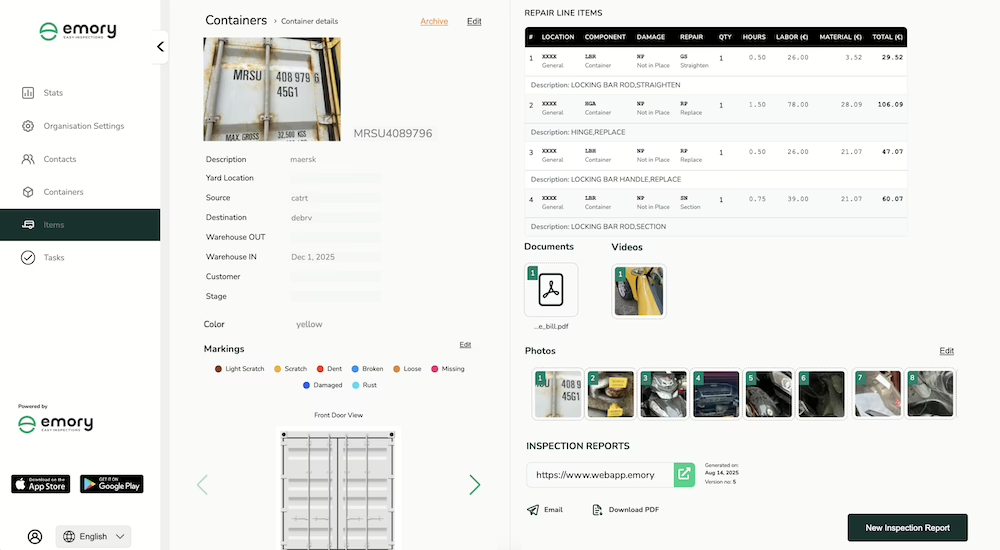
After deploying Emory Pro across their depot network, Cross-Trans established a standardised inspection protocol at each custody transfer point. Pre-loading photographs are now taken within the Emory Pro application, capturing GPS coordinates and server-side timestamps at the moment of capture. Checklists are completed in sequence, with mandatory photograph capture at damage-sensitive inspection points.

The operational change was immediate: disputes that previously required protracted negotiation were resolved rapidly by presenting the inspection record, a timestamped, GPS-verified, photographic record of cargo condition at loading and delivery, produced by an authenticated inspector, with an unbroken chain of custody. Opposing parties found the records difficult to contest.

The Technical Requirements for Dispute-Proof Cargo Inspection

Photo-Proof Container Reports as an Operational Control System

Pre-Loading Inspection Protocol

The pre-loading inspection is the most critical documentation point for cargo dispute prevention. The record must establish:

  • The identity of the cargo (unit number, seal number, container reference, or shipment identifier)
  • The condition of the cargo at loading, photographs of all sides, any pre-existing damage clearly documented with close-up photographs
  • The time of loading, system-generated timestamp, not inspector-entered
  • The location of loading, GPS coordinates captured at the time of inspection, confirming the loading point
  • The identity of the inspector, system-authenticated, not a typed name
  • Acknowledgment by the shipper or their representative, where a CMR or similar handover document is relevant, the inspection record should reference it

Photographic Standards for Cargo Documentation

Photographs of cargo for dispute prevention purposes should meet the following standards:

  • Full exterior coverage, photographs of all four sides of a container, vehicle, or pallet. A photograph of three sides does not establish the condition of the fourth.
  • Close-up documentation of damage, any pre-existing damage should be documented with a close-up photograph that shows the damage clearly, plus a context photograph showing where on the cargo the damage is located
  • Seal documentation, for sealed containers, a photograph of the seal with the seal number clearly visible establishes the seal condition at loading. A broken seal at delivery, compared to the loading seal photograph, is straightforward evidence.
  • Capture within the inspection application, photographs captured in the inspection application carry system-generated metadata. Photographs from native camera apps do not.

CMR Documentation Integration

For international road transport covered by the CMR Convention, inspection records should align with the CMR consignment note documentation requirements. The CMR Convention provides that the absence of reservations by the carrier at the time of loading creates a presumption that cargo was in good condition, making pre-loading inspection records essential for establishing that any reservations were properly noted.

Digital inspection systems used in CMR-covered transport should enable the inspection record to reference the CMR consignment note number, creating a documented link between the inspection record and the legal transport document.

Aggregate Impact: Measuring the Dispute Prevention ROI

The return on investment from dispute-proof cargo inspection documentation is measurable in three categories:

  • Direct claim cost reduction, disputes resolved by inspection records rather than legal process cost a fraction of litigated claims. A logistics company handling 200 shipments per month with a 2% damage dispute rate, four disputes per month, can achieve significant savings if those disputes resolve in days rather than months
  • Insurance premium impact, insurers assess cargo damage claim frequency and value in determining premium rates. A sustained reduction in cargo damage claim payouts, enabled by inspection documentation that resolves disputes in the company’s favour, can produce meaningful premium reductions over time
  • Client retention, logistics clients who experience rapid, evidence-based resolution of cargo disputes retain confidence in their provider. Clients who experience prolonged disputes, regardless of outcome, are more likely to evaluate alternatives
Key Takeaway: The logistics companies that win cargo damage disputes are not necessarily the ones with the best handling practices. They are the ones with the best inspection documentation, specifically, GPS-tagged, timestamped, photographically evidenced records of cargo condition at every custody transfer point. Building this documentation infrastructure is the most reliable investment in cargo dispute prevention available to logistics operators.


Start your free trial today.

Teams adopt Emory Pro not when inspections fail—but when evidence starts getting questioned.