How AI and Automation Improve Inspection Workflows?

AI improve inspection workflows

Artificial intelligence is being integrated into Digital inspection workflows across logistics, manufacturing, construction, and food production. The results, where AI is deployed thoughtfully, are meaningful: faster report generation, more consistent defect detection, reduced administrative overhead, and better compliance outcomes.

But AI in inspection is not uniformly beneficial. Deployed without understanding its limitations, AI can create new risks: false confidence in automated assessments, inconsistent performance across different inspection contexts, and liability exposure when an AI-assisted decision proves wrong.

This article examines what AI and automation actually do well in inspection workflows, where they introduce risk, and how to design an AI-augmented inspection process that is more reliable than a purely manual one.

What AI Does Well in Inspection Contexts

Consistent Checklist Enforcement
Consistent Checklist Enforcement

Human inspectors, under time pressure or fatigue, skip items. They complete sections out of order. They accept ambiguous evidence when clearer evidence is available.

AI-enforced workflows address this by making checklist completion mandatory through a digital inspection checklist, ensuring every step is completed before moving forward.

This is not a dramatic AI application, but it is one of the most impactful. The leading cause of inspection failures in manual systems is not inspector incompetence — it is inspection items that were completed inconsistently or skipped. Consistent enforcement of checklist sequence and completion requirements removes this failure mode.

Automated Report Generation
Automated Report Generation

In manual inspection processes, a significant portion of an inspector’s time is spent not on inspecting but on report writing. Transferring findings from field notes to a formal report, formatting photographs, writing narrative summaries — these tasks can consume as much time as the inspection itself.

Automated report generation eliminates this overhead. When an inspector completes a digital inspection, the report is generated immediately from the captured data: findings are formatted, photographs are embedded with their metadata, and the document is available within seconds of inspection completion.

The inspector’s time is freed for actual inspection.

Pattern Detection Across Large Inspection Datasets
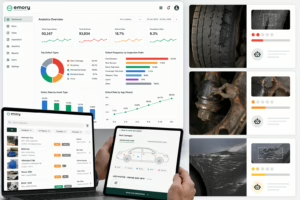
One of AI’s most powerful applications in inspection is the analysis of large datasets to identify patterns that would not be visible to an individual inspector.

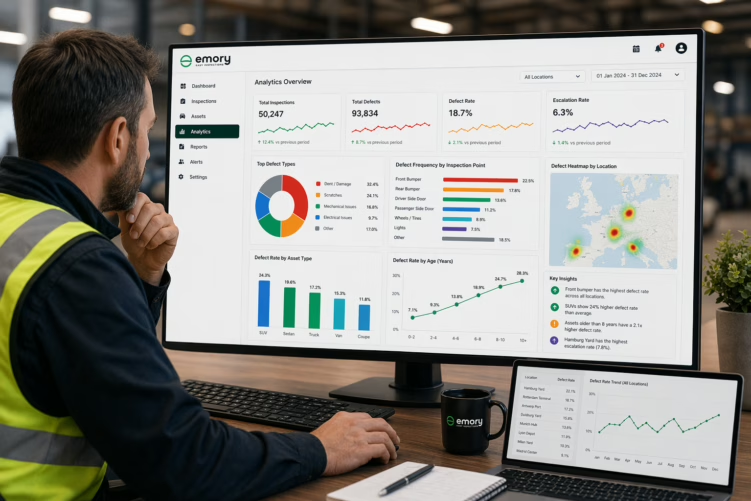
When thousands of inspection records are analysed, AI can identify which inspection points are most frequently associated with defects, which asset types fail most often at which mileage or age, and which locations produce the most escalations.

This aggregate intelligence enables predictive maintenance scheduling, targeted inspection resource deployment, and process improvements that individual inspection results would not suggest. A single inspector cannot see across 50,000 inspection records. AI can.

Anomaly Detection in Photo Evidence
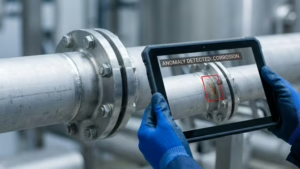
Anomaly Detection in Photo Evidence

Computer vision applications in inspection can flag anomalies in photographs: unusual wear patterns, visible damage, liquid contamination, structural irregularities.

In high-volume inspection environments where inspectors review hundreds of similar assets per day, computer vision can serve as a consistent second check — surfacing items that might be missed in a fatigued inspection.

This capability is genuinely useful, particularly in contexts where defects are visually distinctive and consistent — surface corrosion, liquid staining, visible dents. It is less reliable in contexts where defect assessment requires judgment, contextual knowledge, or tactile information that a photograph cannot capture.


Where AI Fails in Inspection And Why This Matters?

Where AI Fails in Inspection, And Why This Matters

The most dangerous application of AI in inspection is not bad AI — it is AI that is confident when it should not be. An AI system that consistently flags obvious damage will correctly identify most visible defects. The defects it misses are the ones that are not obvious. And those are the ones that matter most.

Novel Defects and Edge Cases

AI systems trained on inspection data perform well on defects that are similar to those in their training data. They perform poorly on novel defects — damage types, failure modes, or conditions that are rare or contextually unusual. An AI system that has seen 10,000 photographs of tyre wear will reliably identify standard tyre wear. It may not identify an unusual wear pattern caused by an alignment problem that is itself a safety issue.

This limitation is particularly significant in safety-critical inspections. The defects that matter most are often the ones that are unusual — because if they were common, they would already be standard items on the checklist. AI should not be the primary detection mechanism for safety-critical edge cases.

Accountability and Legal Exposure

When an AI-assisted inspection misses a defect that subsequently causes harm, the question of accountability is complex. If the inspector was relying on AI flagging to identify defects, and the AI did not flag a defect that a human inspector might have identified, who bears responsibility?

This is not a hypothetical concern. It is an active area of legal and regulatory development in several jurisdictions. Organisations deploying AI in safety-critical inspection contexts need clear policies on the respective roles of AI and human judgment, and clear documentation of which decisions were made by AI and which by a human.

Inconsistency Across Environmental Conditions

Computer vision systems trained in controlled conditions — good lighting, consistent camera angles, clean backgrounds — often perform inconsistently in field conditions: poor lighting, irregular angles, backgrounds that vary across locations. An AI system that performs well in a controlled depot inspection may perform significantly worse at a remote construction site or in adverse weather.

Organisations deploying AI inspection tools should validate performance across the full range of their inspection contexts, not just in the conditions that look most like the training environment.

Designing an AI-Augmented Inspection Workflow That Works

Designing an AI-Augmented Inspection Workflow That Works

The most effective AI-augmented inspection workflows treat AI as an enhancement to human judgment, not a replacement for it. The design principles that produce reliable outcomes are:

  • AI handles consistency and scale; humans handle judgment, use AI to enforce checklist completion, generate reports, and analyse patterns. Use human inspectors for contextual assessment, novel situations, and safety-critical decisions
  • AI flags, humans confirm, when AI identifies a potential anomaly, route it to a human inspector for confirmation rather than treating the AI flag as a finding. This preserves the speed benefit of AI detection while maintaining human accountability
  • Document the AI/human boundary, for every inspection decision, the record should indicate whether it was AI-assisted or human-made. This is both good practice and increasingly a regulatory requirement
  • Validate in context, before deploying AI inspection tools across an operation, test them in the specific conditions of that operation. Performance in a vendor demonstration is not performance in field conditions
  • Maintain human inspection capacity, do not allow AI deployment to result in a reduction in inspector training and capability. AI systems fail; when they do, human inspectors need to be capable of performing the inspection reliably

How Emory Pro Integrates AI and Automation?

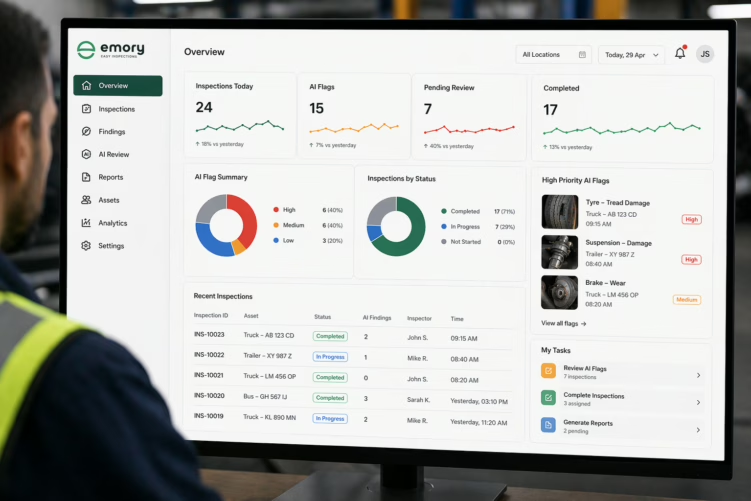
Emory Pro uses automation and AI at the workflow layer, enforcing checklist completion, routing findings automatically, generating reports instantly, and providing aggregate analytics across inspection datasets. The platform does not replace human inspector judgment; it structures the context in which that judgment is exercised.

Inspectors using Emory Pro complete checklists that enforce sequence and mandatory evidence capture. Reports are generated immediately on submission. Findings are routed automatically to the appropriate reviewer. Aggregate dashboards surface patterns across the full inspection dataset.

Where computer vision is used to flag anomalies in photographs, the platform presents these as flags for human review, not as autonomous findings. The human inspector confirms or dismisses the flag, and their decision is documented. The AI assists; the inspector decides; the system records.

Key Takeaway: AI in inspection workflows delivers genuine value in consistency enforcement, report automation, and pattern detection. It introduces risk when deployed as a replacement for human judgment in contexts requiring contextual assessment, novel defect identification, or safety-critical decisions. The inspection operations that benefit most from AI are the ones that design the AI/human boundary carefully and document it clearly.

FAQ’s

AI improves inspection workflows by making them faster, more consistent, and easier to manage. It ensures that every checklist step is completed, automatically generates reports, and helps teams identify patterns across inspections.

At Emory Pro, we’ve seen that teams save significant time on manual reporting and reduce errors by using structured digital inspection workflows.

No, AI cannot fully replace human inspectors.

AI is useful for automation, data analysis, and detecting common issues. However, human inspectors are still needed for decision-making, understanding complex situations, and handling safety-critical inspections.

That’s why Emory Pro uses AI to support inspectors – not replace them.

The main risks include over-reliance on AI, missing unusual defects, and inconsistent performance in real-world conditions.

AI works best when combined with human review. At Emory Pro, AI is used to flag potential issues, but final decisions are always made by a human inspector to ensure accuracy and accountability.

Start your free trial today.

Teams adopt Emory Pro not when inspections fail—but when evidence starts getting questioned.